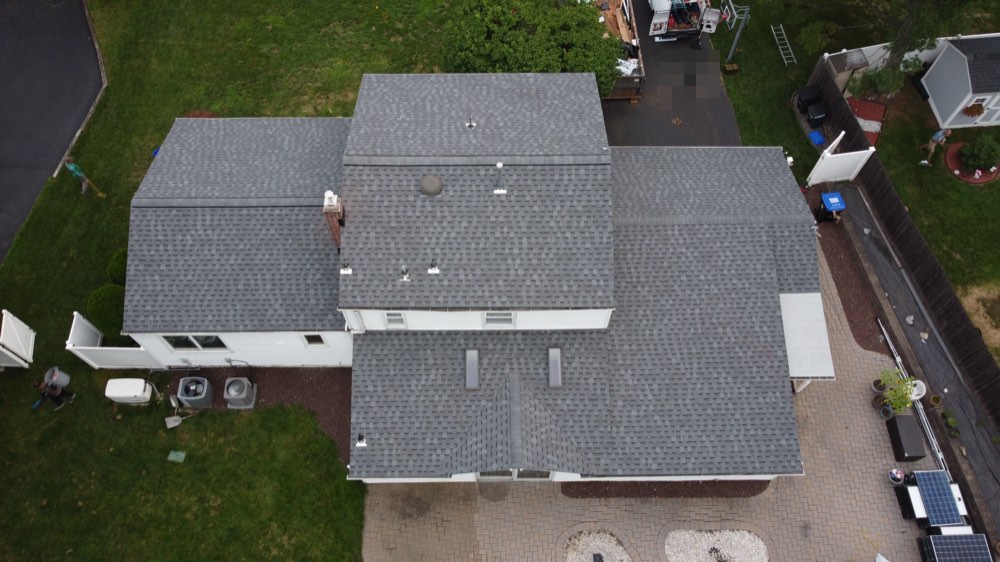
Rockaway Township's lake communities began as resort developments, and most of their houses were built in the building boom after World War II. Many started modest in size. Over the following decades, owners added bedrooms, enclosed porches and raised dormers, usually one project at a time, so many of these roofs were never planned as a whole.
Roofing an older lake home means removing every old layer, rebuilding the joints where additions meet the original house, giving low-slope sections a proper membrane, and fixing attic ventilation so the roof can handle year-round heat. Those details matter more here than the shingle brand.
Why do older lake homes have so many roof problems?
Older lake homes have so many roof problems because each addition was built separately, often with different pitches and quick tie-ins, and the original attic usually has thin insulation and little ventilation. Leaks tend to start where sections meet and on roofs too flat for shingles.
A typical example: a steep gable over the original house, a shed roof over a bedroom added in the 1960s, a nearly flat roof over a porch that was later enclosed, and a dormer from a more recent renovation. Each joint between them is a chance for water to get in, and each was usually sealed with whatever was handy at the time.
What happens to the low-slope sections?
Low-slope sections get a membrane roof designed for shallow pitches instead of shingles, flashed into the shingled areas around them. Shingles need enough slope to shed water; on a near-flat porch roof, wind-driven rain gets pushed under them.
Enclosed porches and connectors are the usual suspects. If yours leaks every heavy rain while the main roof stays dry, the pitch is probably too low for what's on it. We measure each section during the inspection and price the right material for each one.
Why does attic ventilation matter so much?
Attic ventilation matters because many older lake homes have little insulation, blocked or missing soffit vents and no ridge vent. When the house is heated all winter, warm air reaches the roof deck, melting snow into ice dams and leaving condensation that rots the sheathing.
During a re-roof we can add a ridge vent and, if the soffits allow, intake vents at the eaves. Sealing gaps around light fixtures and the attic hatch from inside does the rest. Our guide to frost in the attic explains the moisture side.
What else turns up during tear-off?
During tear-off on an older lake home, it's common to find two or three old shingle layers, board sheathing with gaps, soft wood under past leaks and rafters that were sistered or patched. All of it is priced in advance so the total stays predictable.
Older board decking can sometimes stay if it's sound, with plywood added where needed. If sheathing has to be replaced, a construction permit is required, and we file it. On small lake lots, we also plan where the dumpster goes and protect neighbors' property and plantings.
Is it worth replacing the whole roof at once?
Replacing the whole roof at once is worth it when most sections are worn, because every joint gets rebuilt and the colors match. When one section, such as a porch roof, is failing well ahead of the rest, that piece can be redone on its own.
We'll show you both options with photos and prices, so you can decide what makes sense for the house and the budget.
Planning work on a lake home? Request a free inspection, or see roof replacement in Rockaway Township.
Need help with this in Rockaway Township?
We'll take a look and give you a free written quote. Learn more about roof replacement in Rockaway Township.